Laçiner: societal mobilisation needed to save HDP
Ömer Laçiner in Birikim warns that the election campaign for the November 1 election will maybe be Turkey’s historically most violent one – including lynching, mass clashes, and provocations – with the highest number of casualties and incidents ever. The HDP is never going to enjoy the same kind of freedom of action that it enjoyed in the run-up to the June 7 election; that is because the party is going to be under extreme stress, subject to the AKP government’s schemes to criminalize it by mobilizing the “state.” This means that we need another constructive element, which by definition cannot be any of the political parties. A new “subject” has to enter the political equation. This “subject” should be borne out of a movement that conveys the messages of peace, brotherhood, and the feeling of justness to the society, by its own initiative. Such a movement would bring about a societal mobilization that ensures that the Turks among the citizens of the country by their votes make HDP the party that represents the whole of Turkey, this time also in the ethnic proportions of its votes.
Baydar: silencing media to win the election
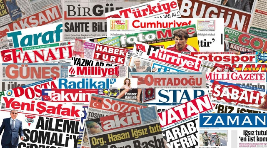
Yavuz Baydar in Bugün asks, what kind of game is it that is being played openly now with the suffocation of media? The preservation of power depends on the emergence of a three-party parliament at the polls on November 1. An equation of four parties will spell disaster. Thus, it is absolutely necessary on the hand that the HDP is left out of the parliament, and on the other hand, that MHP is undermined and its votes transferred to AKP. In order to achieve these goals, a never before seen manipulation of public opinion is called for. The “silent majority” in Turkey – the lower and middle classes – (at a rate of around 80 percent) follow only the TV channels as sources of information. And note that the efforts of the government to cut the media down to size have always been concentrated on the media groups that have TV channels. Of course, the turn will come to independent newspapers like Cumhuriyet, Taraf, Sözcü and Birgün as well after this. If their attempts to suffocate the media results in a backlash, if the distribution of votes among the parties do not change, the option to postpone these elections is kept as a card in the cupboard.
The Islamization of Turkey: Erdoğan’s Education Reforms
By Svante E. Cornell (vol. 8, no. 16 of the Turkey Analyst)
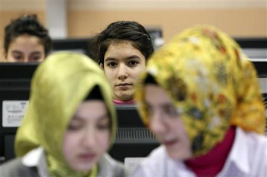
The growing efforts at Islamization of Turkish society have largely gone unnoticed. For many years, Islamization was the dog that did not bark: in spite of dire predictions by secularists, the AKP did not introduce conspicuous efforts to Islamize Turkey. But since 2011, this has changed. The main exhibit is the education sector, which President Recep Tayyip Erdoğan has remodeled to instill considerably more Islamic content, in line with his stated purpose to raise “pious generations”. Ultimately, the Islamic overhaul of the education system is bound to have implications for Turkey’s civilizational identity, and on the choices it will make on where it belongs politically.
Turkey’s New Caretaker Government is a Pure AKP Government in Disguise
By M. K. Kaya (vol. 8, no. 16 of the Turkey Analyst)
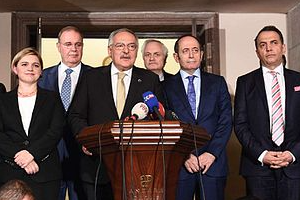
In violation of the Turkish constitution, Ahmet Davutoğlu’s new caretaker cabinet is a pure AKP government. The government may be temporary, but it is nonetheless nothing but an expression of the determination of the AKP to secure permanent power. Both the process that led to its formation and its extra-constitutional composition bears testimony to the power-grab of the AKP.
What the Columnists Say

Etyen Mahçupyan in Akşam writes that the cease-fire ended because PKK started to seek independence in Rojawa, and because Turkey did not want to have a PKK state at its border. “PKK has shot itself in the foot,” he writes. Metin Münir on the t24 news site finds it incredible that PKK chose to respond to Erdoğan’s restart of the war in what he describes as the most stupid way possible, by returning to terrorism. Orhan Bursalı in Cumhuriyet writes that PKK is laying the ground for secession from Turkey. Kemal Öztürk in Yeni Şafak warns the AKP that the party is losing the public relation battle to PKK among the Kurds, and that yet another electoral disaster is looming. Şahin Alpay in Zaman writes that even though Erdoğan is the chief responsible for why calm and stability continue to elude Turkey, the fundamental reasons for this are inscribed in the genetic code of the republic.
Visit also




Joint Center Publications
Op-ed Halil Karaveli "The Rise and Rise of the Turkish Right", The New York Times, April 8, 2019
Analysis Halil Karaveli "The Myth of Erdogan's Power", Foreign Policy, August 29, 2018
Analysis Svante E. Cornell, A Road to Understanding in Syria? The U.S. and Turkey, The American Interest, June 2018
Op-ed Halil Karaveli "Erdogan Wins Reelection", Foreign Affairs, June 25, 2018
Article Halil Karaveli "Will the Kurdish Question Secure Erdogan's Re-election?", Turkey Analyst, June 18, 2018
Research Article Svante E. Cornell "Erbakan, Kisakürek, and the Mainstreaming of Extremism in Turkey", Current Trends in Islamist Ideology, June 2018
Analysis Svante E. Cornell "The U.S. and Turkey: Past the Point of No Return?", The American Interest, February 1, 2018
Op-ed Svante E. Cornell "Erdogan's Turkey: the Role of a Little Known Islamic Poet", Breaking Defense, January 2, 2018
Research Article Halil Karaveli "Turkey's Authoritarian Legacy", Cairo Review of Global Affairs, January 2, 2018