What the Columnists Say

Several columnists express concern over Turkey’s future after the violent clashes in the Kurdish parts of the country and the government’s reaction to them. Cengiz Çandar writes that the leadership of the country has not learnt the right lessons and that it is mistaken in thinking that police state methods are going to save the day. Yetvart Danzikyan warns that the methods of the AKP government are inflaming ethnic and sectarian tensions and that the situation could get out of hand. Abdülkadir Selvi writes that Turkey is not going to give in to the pressures of the United States regarding the use of its bases in the fight against ISIS and reminds that Turkey demands that the Sunnis in Syria and Iraq are empowered and that the Assad regime in Syria is removed from power.
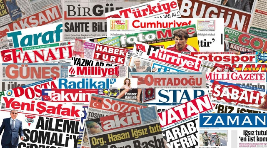
What the Columnists Say

The question that continues to preoccupy many commentators in the Turkish press is the direction that President Erdoğan is taking Turkey. Baskın Oran, a leading political scientist and pundit, drew a historical parallel to the epochs of Atatürk and the sultan Abdülhamid II, noting that Erdoğan is copying Atatürk in his methods, while copying Abdülhamid II ideologically. Meanwhile, the statement that General Necdet Özel, the Chief of the General Staff of the Turkish military, made during the official state reception on August 30 that the military is held in the dark about the peace negotiations between the government and the Kurdish movement and that the military is going to react if its “red lines” are crossed, was welcomed in a comment in the daily Zaman. It was noted that the words of the military deserves to be listened to and that a solution that lacks the support of the armed forces does not stand any chance of success.
Is Turkey's Kurdish War About to End?
By Halil M. Karaveli (vol. 3, no. 17 of the Turkey Analyst)
At this stage, the Turkish government remains unprepared to commit itself to the kind of constitutional changes that the Kurdish movement requests. Yet a dialogue has presently gotten under way between the Turkish state and the Kurdish movement. If that dialogue can be sustained over a longer period of time, the prospects for a resolution of Turkey’s intractable conflict would look brighter than ever.
Preparing a 'Decisive Blow' to the PKK, Ankara May Only be Postponing a Solution to its Kurdish Problem
By Halil M. Karaveli (vol. 3, no. 13 of the Turkey Analyst)
After the failure of the Kurdish opening and the offensive of the PKK, Turkey gropes for a way out of its Kurdish impasse. Recent statements by the Turkish Chief of the General staff General İlker Başbuğ suggest that a major military incursion into northern Iraq to stamp out the PKK is being considered. Yet it is unlikely that the Turkish state leadership truly believes that there is a military solution to the challenge posed by the demands of the Kurdish population. The moment when that challenge will have to be properly addressed is only being postponed.
Violence Against Politicians in Turkey Raises the Spectre of Destabilization
By Halil M. Karaveli (vol. 3, no. 8 of the Turkey Analyst)
The recent physical attacks on politicians in Turkey raise the specter of destabilization. The Turkish government speculates that the attacks are coordinated by forces within the state security establishment. The incidents obviously occur within a wider context of ideological manipulation. Turkish ultra-nationalism has developed and spread during the last decade. It seems that the punch, rather than the outstretched hand, and irrationality are set to define the future of Turkish-Kurdish relations.
Visit also




Joint Center Publications
Op-ed Halil Karaveli "The Rise and Rise of the Turkish Right", The New York Times, April 8, 2019
Analysis Halil Karaveli "The Myth of Erdogan's Power", Foreign Policy, August 29, 2018
Analysis Svante E. Cornell, A Road to Understanding in Syria? The U.S. and Turkey, The American Interest, June 2018
Op-ed Halil Karaveli "Erdogan Wins Reelection", Foreign Affairs, June 25, 2018
Article Halil Karaveli "Will the Kurdish Question Secure Erdogan's Re-election?", Turkey Analyst, June 18, 2018
Research Article Svante E. Cornell "Erbakan, Kisakürek, and the Mainstreaming of Extremism in Turkey", Current Trends in Islamist Ideology, June 2018
Analysis Svante E. Cornell "The U.S. and Turkey: Past the Point of No Return?", The American Interest, February 1, 2018
Op-ed Svante E. Cornell "Erdogan's Turkey: the Role of a Little Known Islamic Poet", Breaking Defense, January 2, 2018
Research Article Halil Karaveli "Turkey's Authoritarian Legacy", Cairo Review of Global Affairs, January 2, 2018