The Return of the Generals

By Halil Karaveli (vol. 7, no. 21 of the Turkey Analyst)
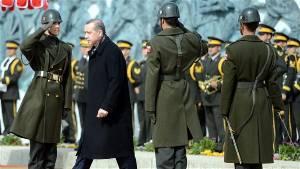
The Turkish generals are no longer afraid to speak out and they exert influence over government policies. Erdoğan invited the military back into the power equation when, faced with the Gülenist challenge to his power, and in need of a new ally, he gave the signal to open the prison doors for the convicted officers. But more than anything else, it is the persistence of an authoritarian mindset that sets the stage for the recurrent assertion of the power of the military in Turkey.
The AKP Uses the “Solution Process” to Suspend the Freedom of Expression

By Burak Bilgehan Özpek (vol. 7, no. 21 of the Turkey Analyst)
The strategies of the Turkish state to deal with the Kurdish question has undergone a dramatic change since the 1990s, but what has remained constant is the state’s stance toward freedom of expression. The ruling party of Turkey has repeatedly demonstrated that it uses lofty goals like democratization to severely restrict the freedom of expression and to suspend the rule of law. “Peace” is another such goal. The AKP’s strategy in the “solution process” with the Kurdish movement rests on keeping the process secret, and stigmatizing and intimidating those who raise questions. The AKP’s strategy indicates that “peace” can be just as viable as a strategy to secure and defend authoritarian power as armed conflict.
What the Columnists Say

President Erdoğan is serious about building a mosque in Cuba and in his allegation that Muslims discovered America before Columbus, contends Fatih Yaşlı. The latest remarks of Erdoğan speak of the ideological nature of his regime, he writes. Mümtaz’er Türköne writes that the new, 1,000 room presidential palace of Erdoğan is a monument to the suspension of the rule of law. Murat Belge observes that ridding Turkey of Atatürkism has not ushered in democracy. A new Turkey will be born the day power holders abandon their palatial ambitions, Belge writes. Elif Çakır worries that there is still a risk of a military coup. Abdülkadir Selvi presents the news that Abdullah Öcalan is going to announce early next year that PKK permanently gives up the armed struggle in Turkey.
What the Columnists Say

The fact that the military has returned to playing a political role in the wake of the Kobane events, with the General Staff making several emotionally charged statements on the Kurdish issue, has started to be noted with growing alarm by some commentators. Ali Bayramoğlu in Yeni Şafak warns that in a country with Turkey’s history, its political culture, with its deep societal divisions and with ongoing regional developments, the door is not closed to a return of the military. He notes that the Kurdish issue is of critical importance and reminds that what prompted the military return to politics in the 1990s was precisely the Kurdish issue. Other commentators worry about the consequences of regional developments. While pro-government pundits accuse the United States of harboring imperialist designs against Turkey, critics of the government charge that it invites severe troubles by its ideologically motivated refusal to dissociate itself from what ISIS stands for.
What the Columnists Say

The question that continues to preoccupy many commentators in the Turkish press is the direction that President Erdoğan is taking Turkey. Baskın Oran, a leading political scientist and pundit, drew a historical parallel to the epochs of Atatürk and the sultan Abdülhamid II, noting that Erdoğan is copying Atatürk in his methods, while copying Abdülhamid II ideologically. Meanwhile, the statement that General Necdet Özel, the Chief of the General Staff of the Turkish military, made during the official state reception on August 30 that the military is held in the dark about the peace negotiations between the government and the Kurdish movement and that the military is going to react if its “red lines” are crossed, was welcomed in a comment in the daily Zaman. It was noted that the words of the military deserves to be listened to and that a solution that lacks the support of the armed forces does not stand any chance of success.
Visit also




Joint Center Publications
Op-ed Halil Karaveli "The Rise and Rise of the Turkish Right", The New York Times, April 8, 2019
Analysis Halil Karaveli "The Myth of Erdogan's Power", Foreign Policy, August 29, 2018
Analysis Svante E. Cornell, A Road to Understanding in Syria? The U.S. and Turkey, The American Interest, June 2018
Op-ed Halil Karaveli "Erdogan Wins Reelection", Foreign Affairs, June 25, 2018
Article Halil Karaveli "Will the Kurdish Question Secure Erdogan's Re-election?", Turkey Analyst, June 18, 2018
Research Article Svante E. Cornell "Erbakan, Kisakürek, and the Mainstreaming of Extremism in Turkey", Current Trends in Islamist Ideology, June 2018
Analysis Svante E. Cornell "The U.S. and Turkey: Past the Point of No Return?", The American Interest, February 1, 2018
Op-ed Svante E. Cornell "Erdogan's Turkey: the Role of a Little Known Islamic Poet", Breaking Defense, January 2, 2018
Research Article Halil Karaveli "Turkey's Authoritarian Legacy", Cairo Review of Global Affairs, January 2, 2018